In this article
Two small spoonfuls can look very different: olive-brown sturgeon caviar in one, bright orange roe in the other. Both may belong at the same table, but they are not interchangeable simply because they are fish eggs. Naming the fish and thinking about the dish will help you choose more confidently than colour or prestige alone.
ANNA Dutch separates its UAE range into a Caviar Collection and a Roe Collection.[7][10] That is a helpful distinction to keep in mind while browsing. This guide compares the stated product characteristics, then suggests how to put those differences to use.
Roe is the broader word
Roe is the general term for fish eggs.[27] Here, “sturgeon caviar” refers to the prepared roe sold as Osetra, Beluga and Sevruga in ANNA Dutch's collection. The regulatory definition in US CITES rules is broader than sturgeon alone: it includes processed roe of sturgeon or paddlefish.[21] Salmon and trout roe are not those fish.
You may still see “red caviar” or “trout caviar” used in product descriptions. Read past that wording to the named species. It tells you what the product is, even when familiar culinary or marketing terms overlap. This is a buying and serving distinction, not a guide to UAE labelling law.
Sturgeon caviar: begin with the variety
ANNA Dutch identifies Osetra as Acipenser gueldenstaedtii, Beluga as Huso huso, and Sevruga as Acipenser stellatus.[7][8][9] Its Osetra description emphasises creamy, almost nutty notes and dark olive to dark brown pearls.[7]
If you want the caviar itself to lead a small tasting, choose a variety whose description appeals to you and try it plain before adding food. For a dish, think about how much of the caviar's texture and character you want to notice. A strong sauce and a large garnish can turn the purchase into a detail you barely taste.
The product name is a starting point, not an absolute forecast. ANNA Dutch's UAE guidance notes natural variation in size, colour, texture and flavour.[17] You can learn your preferences without expecting every tin to reproduce the first one exactly.
Chum roe and the salmon roe listing are different products
The Chum Roe page identifies Oncorhynchus keta and describes orange-red eggs, a briny flavour and a distinct pop. It lists a pearl size of 7–8 mm.[10] Chum is a salmon; the separate name helps distinguish this roe within the range.[26]
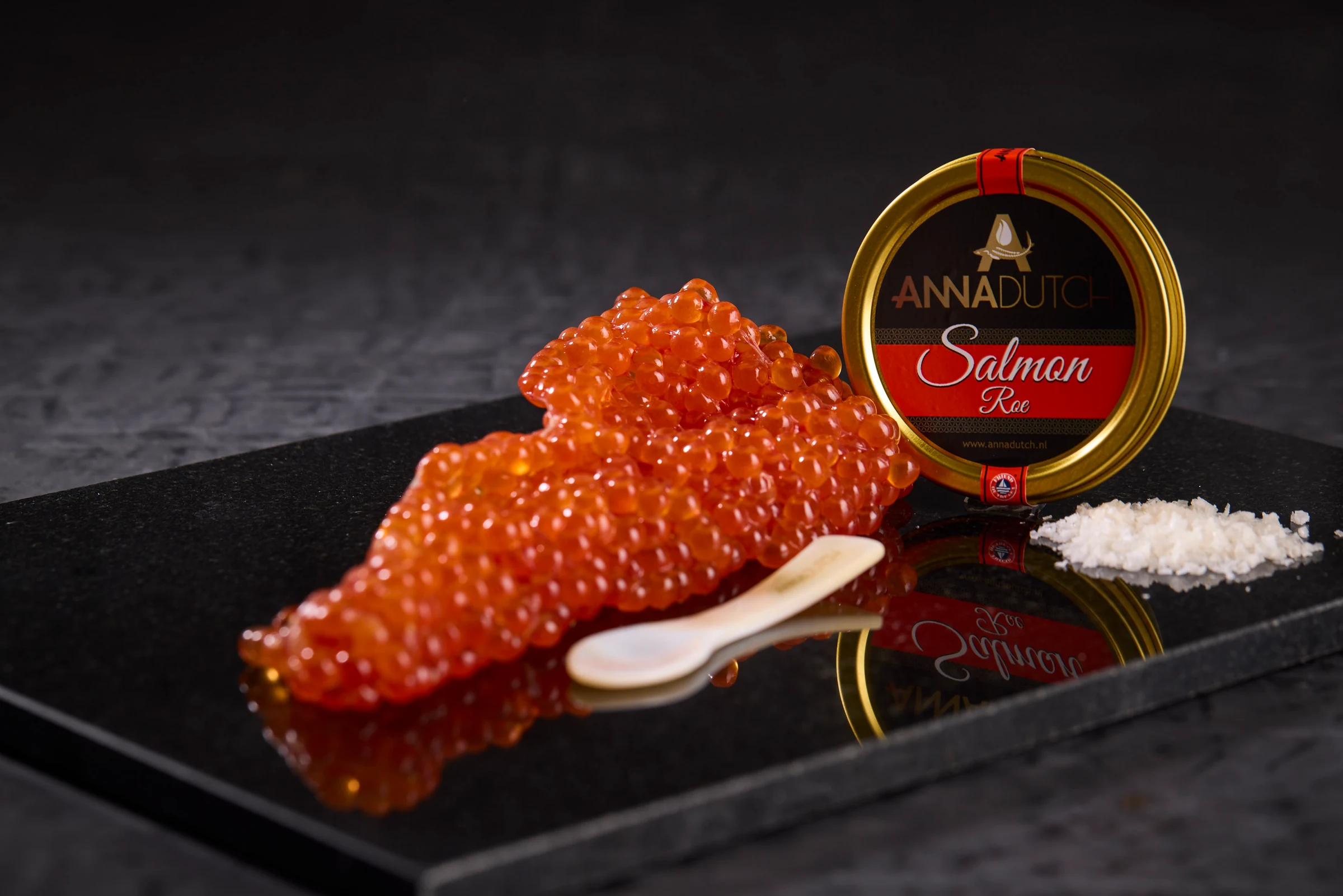
The product sold as Salmon Roe identifies Oncorhynchus gorbusha. Its description lists bright orange pearls of 4–5 mm and emphasises juicy sweetness and a flavour of the sea.[12] These are ANNA Dutch's product descriptions, not size guarantees for every egg of either species.
For a rice bowl or a composed small dish, consider how prominent you want each pearl to be. The larger size described for the chum product suggests a different visual and textural choice from the smaller salmon roe listing. Start with a little on the food and taste before adding another spoonful.
Trout roe offers another scale
The Trout Roe page names Oncorhynchus mykiss, describes yellow to bright orange colour and lists pearls of 2–3 mm.[11] That gives you a specific reason to consider it when you want a smaller orange-coloured garnish rather than the larger pearls described for chum.
Try imagining the finished bite before choosing. A small piece of toast with a little plain dressing, or a neatly portioned cooked potato, leaves room to notice the roe. Treat it as an ingredient with its own identity rather than a replacement bought only because it resembles something else from a distance.
Match the choice to the food, not a price ladder
For a plain tasting, start with the product you are curious to taste by itself. For a garnish, consider the size of the bite and whether you want colour, a noticeable pop or a more compact layer of pearls. You do not need to call one category superior to enjoy its different role.
Keep the first combination simple. Fully cooked egg, plain rice, potato or toast can each provide a starting point. Make a trial portion before dressing the whole dish, particularly if you plan to add salt, citrus or a strong sauce. These are suggestions for exploring your preference, not a claim that every roe works best with the same recipe.
Ask guests about dietary requirements and read the actual ingredients and allergen information. The UAE product guidance makes those checks the customer's responsibility.[17] Caviar and roe being in different collections does not make either automatically suitable for a particular guest.
Do not borrow storage rules from another tin
Read the label and the supplied directions for the exact product you buy. The FDA's general advice is to check storage instructions on labels.[15] A rule you remember for sturgeon caviar should not become a storage or thawing instruction for another roe product.
For the same reason, do not infer origin from the ANNA Dutch name alone. The brand's Netherlands-based sturgeon farm is part of its caviar story, not evidence that every fish represented in its wider collection was raised there.[2] Ask about the specific product if origin matters to your decision.
Browse the ANNA Dutch UAE collection with the species and dish in mind, then confirm the product, format and timing with the UAE team. A clear choice can be as simple as knowing which fish's roe you want, and what you want to do with it.
Sources and further reading
- [2] ANNA Dutch UAE: The Farm
- [7] ANNA Dutch UAE: Osetra product details
- [8] ANNA Dutch UAE: Sevruga product details
- [9] ANNA Dutch UAE: Beluga product details
- [10] ANNA Dutch UAE: Chum roe product details
- [11] ANNA Dutch UAE: Trout roe product details
- [12] ANNA Dutch UAE: Salmon roe product details
- [15] FDA: Are You Storing Food Safely?
- [17] ANNA Dutch UAE: Care, serving and delivery guidance
- [21] Caviar definition and labelling: 50 CFR 23.71 (Cornell LII)
- [26] NOAA Fisheries: Chum salmon
- [27] Cambridge Dictionary: Roe